
Introduction
If you are building a web application in 2026, the rules have changed. The debate between “Client-Side Rendering” (CSR) and “Server-Side Rendering” (SSR) that dominated the early 2020s is effectively over. The winner is a hybrid approach that changes everything: React Server Components (RSC).
For years, React developers had to choose between the fast interactivity of Single Page Apps (SPAs) and the SEO benefits of server rendering. With React 19 and Next.js 15 becoming the industry standard this year, you no longer have to choose.
This guide explores what RSCs are, why they are statistically superior for 90% of business applications, and how they improve your bottom line through better SEO and lower infrastructure costs.
- What are React Server Components (RSC)?
- The Problem: The “Hydration Tax” of the Past
- How React Server Components Work Under the Hood
- RSC vs. SSR: The Critical Distinction
- Code Comparison: The 2024 Way vs. The 2026 Way
- Business Benefits: Why Upgrade in 2026?
- The Future is “Server-First”
- Conclusion: Adapting to the New Standard
What are React Server Components (RSC)?
React Server Components are a new type of React component that renders exclusively on the server. Unlike traditional Server-Side Rendering (SSR), RSCs never send their JavaScript code to the client browser.
Key Differences in 2026:
- Zero Bundle Size: The code for an RSC is not downloaded by the user, speeding up page loads.
- Direct Backend Access: RSCs can query databases directly (e.g., db.query()) without needing an API layer.
- Automatic Code Splitting: The server decides what the client needs, reducing bandwidth usage by up to 30%.
The Problem: The "Hydration Tax" of the Past
To understand why RSC is revolutionary, we must look at how we built apps previously (2018–2024).
In the “Old Era,” even with Server-Side Rendering (SSR), we paid a heavy performance penalty called Hydration.
- Server Renders HTML: The server builds the page and sends it to the user. The user sees the content.
- Browser Downloads JS: The browser then downloads a massive JavaScript bundle containing the logic for that content.
- Hydration: React runs in the browser, attaching event listeners to the HTML to make it interactive.
The Flaw: We were sending the same data twice—once as HTML, and again as JavaScript logic to manage that HTML. If you had a blog post with 5,000 words, you would send the text and the JavaScript to manage that text, even if the text was static.
The Solution: React Server Components remove the JavaScript requirement for non-interactive parts of your UI.

How React Server Components Work Under the Hood
In 2026, with React 19 and frameworks like Next.js 15, the mental model has shifted.
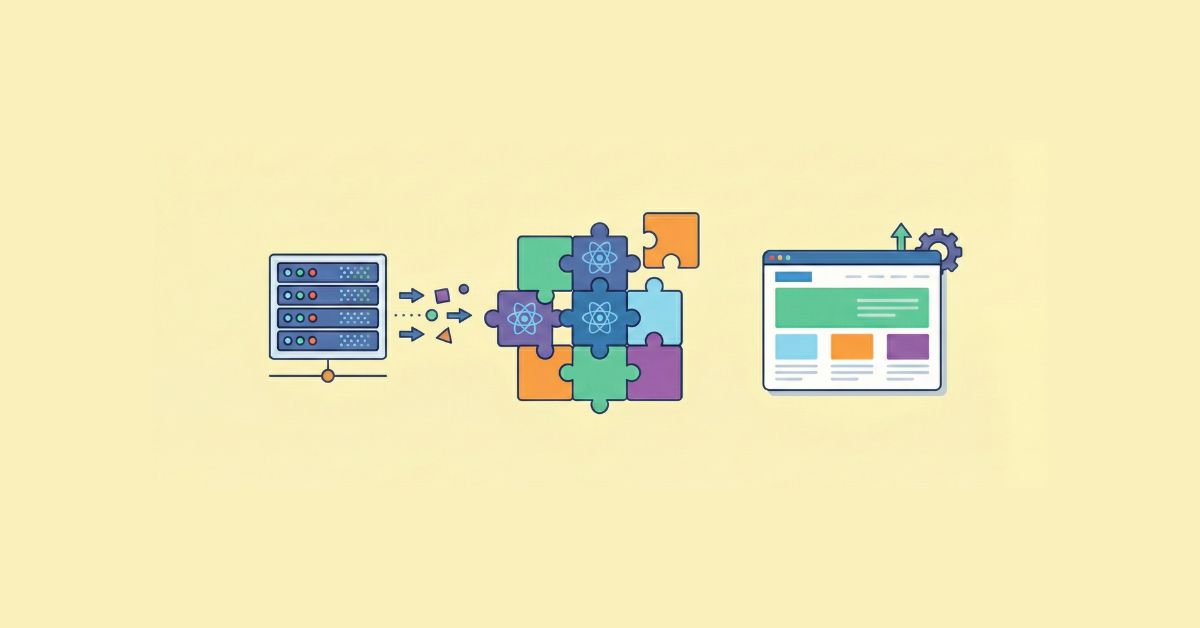
When a user requests a page, the server renders the Server Components. But instead of sending just HTML, it sends a special serialized format called the RSC Payload.
This payload acts like a “blueprint.” The browser reads this blueprint and updates the DOM without needing the original component’s JavaScript code.
The "Waterfal" Myth
A common fear is that rendering on the server causes slow “waterfalls” (waiting for one thing to finish before starting the next). However, the 2026 architecture uses Streaming.
The server can send the UI in chunks. A user might see the header and sidebar (rendered instantly) while the main data table is still fetching from the database. This is handled automatically by React’s <Suspense> boundaries.
RSC vs. SSR: The Critical Distinction
This is the most searched comparison in our industry. It is vital to understand that Server Components are NOT the same as Server-Side Rendering (SSR).
| Feature | Server-Side Rendering (SSR) | React Server Components (RSC) |
|---|---|---|
| Execution Location | Server (initially), then Client (hydration) | Server Only (never on client) |
| JavaScript Bundle | Large (All component code is sent to browser) | Zero (Component code stays on server) |
| Data Access | Requires API routes or getServerSideProps | Direct Database Access (SQL/ORM) |
| Interactivity | Fully Interactive (after hydration) | Non-Interactive (static content) |
| Best For | Initial page load (LCP) | Reducing bundle size, Data fetching, Security |
The 2026 Hybrid Model:
Modern apps use both. The root of your application is a Server Component (for structure and data), which contains “leaves” of Client Components (for interactivity).
Code Comparison: The 2024 Way vs. The 2026 Way
Let’s look at a real-world example: A product page fetching data.
The Old Way (Client-Side Fetch / "use effect")
Requires API endpoints, loading states, and exposes logic to the browser.
// ❌ The Old Way (Client Component)
import { useState, useEffect } from ‘react’;
export default function ProductPage({ id }) {
const [product, setProduct] = useState(null);
const [loading, setLoading] = useState(true);
useEffect(() => {
// We have to wait for the component to mount, THEN fetch
fetch(`/api/products/${id}`)
.then((res) => res.json())
.then((data) => {
setProduct(data);
setLoading(false);
});
}, [id]);
if (loading) return <Spinner />;
return <div>{product.name}</div>;
}
The New Way (React Server Component)
No API route needed. No useEffect. No client-side JS.
// ✅ The 2026 Way (Server Component)
import db from ‘@/lib/db’; // Direct database access
// Async components are native in React 19+
export default async function ProductPage({ params }) {
// This runs ONLY on the server
const product = await db.product.findUnique({
where: { id: params.id }
});
// Render HTML directly. No JS sent to client for this logic.
return (
<div className=”p-4″>
<h1 className=”text-2xl font-bold”>{product.name}</h1>
<p>{product.description}</p>
{/* Interactive parts are imported separately */}
<AddToCartButton productId={product.id} />
</div>
);
}
Business Benefits: Why Upgrade in 2026?
If you are a business owner or stakeholder, you might be asking: “Why should we pay to refactor our app to RSC?”
1. SEO Dominance (Core Web Vitals)
Google’s 2026 algorithm heavily penalizes sites with high “Interaction to Next Paint” (INP) and slow load times.
- RSC Impact: By removing JavaScript from the main thread, the browser is free to handle user interactions instantly.
- Result: Better Core Web Vitals scores = Higher Search Rankings.
2. Reduced Infrastructure Costs
Traditional SPAs required massive API gateways to serve data to the frontend.
- RSC Impact: Because RSCs query the database directly, you can often eliminate entire layers of your API infrastructure. Fewer API calls over the public internet means lower bandwidth bills and less server strain.
3. Improved Security
In a client-side app, you have to be extremely careful not to leak API keys or logic in the browser bundle.
- RSC Impact: Server Components run in a secure environment. You can use private API keys, database passwords, and internal logic directly in the component file. It is physically impossible for this code to leak to the client because the browser never receives it.
Decision Matrix: When to Use "use client"
In Next.js 15/16, every component is a Server Component by default. You opt out by adding the ‘use client’ directive at the top of a file.
Use a Server Component (Default) when:
- You are fetching data (DB, CMS, API).
- You are accessing backend resources (File System).
- You are keeping sensitive information (Tokens, Keys).
- The content is static (Blogs, Product Descriptions, Layouts).
Use a Client Component (‘use client’) when:
- You need useState, useEffect, or useReducer.
- You need browser APIs (window, localStorage, navigator).
- You need event listeners (onClick, onChange).
The Future is "Server-First"
The trajectory of web development has come full circle. We started with server-rendered HTML (PHP/Ruby), moved to complex client-side JS (Angular/React v16), and have arrived at the perfect synthesis: Server-First React.
Implementing React Server Components is not just a technical upgrade; it is a strategic asset. It allows your software development team to ship faster, secure code that ranks better on Google and converts more users.
Conclusion: Adapting to the New Standard
React Server Components are not just a “trend” for 2026; they represent a fundamental architectural shift in how we build for the web. For the last decade, we accepted that “fast interactivity” meant “large JavaScript bundles.” RSCs have finally broken that correlation.
By adopting this server-first mental model, you are effectively future-proofing your application. You get the SEO visibility of a static site, the dynamic power of a server-rendered app, and the instant interactivity of a Single Page Application—all while writing less code.
For businesses operating in competitive markets, staying on legacy Client-Side Rendering (CSR) or traditional SSR is becoming a liability. In an era where Core Web Vitals directly impact revenue and search ranking, the efficiency gains of RSCs are too significant to ignore.
The bottom line: If you are starting a new project or planning a major refactor in 2026, React Server Components (via Next.js) should be your default choice.
Ready to Upgrade Your Tech Stack?
Migrating to the React Server Component architecture can be complex, but the performance payoffs are massive.
At GrapesTech Solutions, we specialize in high-performance Next.js development. Whether you need to migrate a legacy React app or build a scalable e-commerce platform from scratch, our team is ready to help you navigate the 2026 landscape.