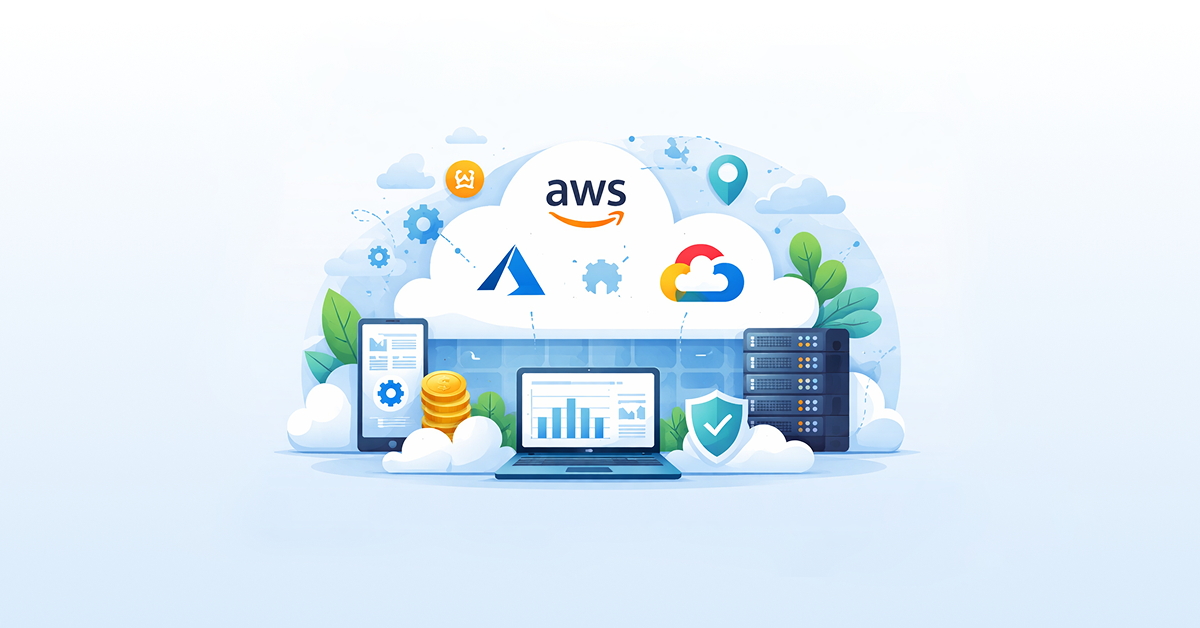
AWS vs Azure vs Google Cloud. Three platforms. Hundreds of services each. And billions of marketing dollars are telling you that each one is the best choice for your business.
If you are a business owner — not a cloud architect — trying to make sense of it all, this guide is for you.
The cloud platform you choose will shape your costs, your team’s productivity, your ability to scale, and your exposure to security risk for years to come. Getting it right matters. And the good news is that you do not need a technical degree to make a smart decision — you just need the right framework.
In this guide, we will break down exactly what AWS, Azure, and Google Cloud each offer, who they are best suited for, and how to evaluate them against your specific business needs. By the end, you will have a clear, confident answer.
- Why Your Cloud Platform Choice Matters More Than You Think
- Understanding the Three Platforms: AWS vs Azure vs Google Cloud
- AWS vs Azure vs Google Cloud: Head-to-Head Comparison
- Which Cloud Platform Is Right for Your Business?
- Eight Questions to Answer Before You Commit
- What to Expect During Your Cloud Migration
- Conclusion: Making the Right Decision for Your Business
- Frequently Asked Questions
Why Your Cloud Platform Choice Matters More Than You Think
For many business owners, choosing a cloud platform feels like a purely technical decision — something to delegate to the IT team and move on from. In reality, it is one of the most consequential infrastructure decisions your business will make. Here is why.
Cost implications
Cloud costs are notoriously easy to underestimate. The pay-as-you-go model is attractive at first glance, but without the right architecture choices from day one, bills can spiral quickly. Idle resources, over-provisioned servers, and inefficient data transfer costs add up fast. The platform you choose — and how you configure it — has a direct impact on your monthly bill.
Vendor lock-in
Once your applications, databases, and workflows are built on a specific platform’s proprietary services, migrating to a different provider becomes enormously expensive and disruptive. It is not impossible, but it typically takes months of engineering work and a significant budget. Choosing thoughtfully upfront is far cheaper than migrating later.
Performance and reliability
All three major cloud providers offer impressive uptime guarantees — typically 99.9% to 99.99% — but performance varies depending on geographic region, workload type, and the specific services you use. A platform with strong data centre coverage in your primary markets will deliver better latency and user experience for your customers.
Security and compliance
Different industries have different regulatory requirements. Healthcare businesses in the United States need HIPAA compliance. Businesses operating in Europe must adhere to GDPR. Financial services companies face their own regulatory frameworks. Each cloud platform has a different portfolio of compliance certifications — and choosing the wrong one could create costly compliance gaps.
GrapesTech insight: The majority of businesses that come to us for cloud migration support made their initial platform choice too quickly — often based on price alone, or because a vendor’s salesperson got there first. The right fit depends on your workload, your team, your compliance obligations, and your long-term growth plans. We always start with a discovery session before recommending anything.
Not sure where to start? Book a free cloud consultation with GrapesTech Solutions — we will assess your needs and recommend the right platform without any vendor bias.
Understanding the Three Platforms: AWS vs Azure vs Google Cloud
Before comparing the platforms head-to-head, it helps to understand what each one is, who built it, and what it was originally designed to do best.
Amazon Web Services (AWS)
AWS launched in 2006 and effectively invented the modern cloud computing industry. Today, it holds approximately 32% of the global cloud infrastructure market, making it the clear market leader by a significant margin.
AWS offers over 200 fully-featured services spanning compute, storage, databases, networking, machine learning, security, analytics, and more. Its global infrastructure includes 33 geographic regions and over 100 availability zones, making it the most geographically distributed of the three platforms. Explore AWS Cloud Computing Services to find the right fit for your workload.
AWS is the platform of choice for startups, e-commerce businesses, media companies, and technology firms that want maximum flexibility and access to the broadest possible service catalogue. If a cloud service exists, AWS almost certainly offers it.
- Most popular AWS services: EC2 (virtual servers), S3 (object storage), RDS (managed databases), Lambda (serverless compute), CloudFront (content delivery network).
- Strengths: largest service catalogue, biggest community, most third-party integrations, widest geographic coverage.
- Considerations: the sheer breadth of services can make AWS overwhelming for teams new to cloud infrastructure.
Microsoft Azure
Microsoft Azure launched in 2010 and has grown to become the second-largest cloud platform globally, with approximately 23% market share. Azure’s defining advantage is its deep, native integration with the Microsoft ecosystem — Office 365, Teams, Active Directory, Dynamics 365, and Windows Server all work seamlessly within Azure. Discover our Azure Services and see how we help businesses migrate seamlessly to Microsoft’s cloud.
Azure is the platform of choice for enterprises that have already invested heavily in Microsoft products, as well as regulated industries such as government, financial services, and healthcare that require an extensive portfolio of compliance certifications. Azure holds more compliance certifications than any other cloud provider — over 90 globally.
- Most popular Azure services: Azure Virtual Machines, Azure Active Directory, Azure DevOps, Azure Kubernetes Service (AKS), and Power BI integration.
- Strengths: Microsoft ecosystem integration, hybrid cloud capabilities (Azure Arc), compliance portfolio, and enterprise support tiers.
- Considerations: Pricing for non-Microsoft workloads can be less competitive; some services lag AWS in maturity.
Google Cloud Platform (GCP)
Google Cloud launched in 2008 — the same year as AWS — but grew more slowly before accelerating significantly in recent years. Today, GCP holds approximately 12% of the global market and is growing faster than its two larger competitors in several key segments.
Google Cloud is built on the same infrastructure that powers Google Search, YouTube, Gmail, and Google Maps — processing more internet traffic than any other organisation in the world. This gives GCP a genuine and demonstrable edge in data processing, analytics, and machine learning workloads. Explore our Google Cloud Services to see how we deploy GCP for data-driven businesses.
Google invented Kubernetes — the open-source container orchestration system that now runs on all three platforms — and its Google Kubernetes Engine (GKE) remains the most mature Kubernetes implementation available. For businesses with data-heavy or AI-driven workloads, GCP is worth serious consideration.
- Most popular GCP services: BigQuery (cloud data warehouse), Vertex AI (machine learning platform), Google Kubernetes Engine (GKE), Cloud Spanner (globally distributed database), Looker (business intelligence).
- Strengths: Data analytics, AI/ML capabilities, per-second billing, Kubernetes expertise, competitive pricing.
- Considerations: smaller community than AWS; fewer third-party integrations; sales and support can be less responsive than competitors.
Related to read: What Is Google Cloud Platform? A Complete Guide to Services and Products of 2025
AWS vs Azure vs Google Cloud: Head-to-Head Comparison
Here is how the three platforms compare across the criteria that matter most to business owners and decision makers.
| Criteria | AWS | Azure | Google Cloud |
|---|---|---|---|
| Market share | #1 — ~32% | #2 — ~23% | #3 — ~12% |
| Founded | 2006 | 2010 | 2008 |
| Best for | Broad workloads & startups | Microsoft stack & enterprise | Data, AI/ML & containers |
| Pricing model | Pay-as-you-go | Pay-as-you-go + hybrid discounts | Per-second + sustained discounts |
| Free tier | 12 months + always-free | 12 months + always-free | Always-free tier (generous) |
| Compliance certs | 300+ programmes | 90+ certifications | Growing portfolio |
| AI/ML services | SageMaker, Rekognition | Azure AI, Cognitive Services | Vertex AI, BigQuery ML |
| Container support | EKS (managed Kubernetes) | AKS (managed Kubernetes) | GKE (Google invented K8s) |
| Hybrid cloud | AWS Outposts | Azure Arc (industry-leading) | Anthos |
| Community size | Largest | Very large (enterprise focus) | Growing fast |
| Learning curve | Moderate | Easy for Microsoft users | Moderate |
Pricing in detail
All three platforms use a pay-as-you-go model — you pay for the compute, storage, and services you consume, with no upfront commitment required. However, the details differ in ways that can have a significant impact on your total cost.
- AWS offers the most comprehensive range of pricing options, including On-Demand, Reserved Instances (discounts of up to 72% for one or three-year commitments), and Spot Instances (unused capacity at up to 90% discount). The breadth of options is powerful but can be complex to navigate without expertise.
- Azure offers competitive pricing for Windows-based workloads and provides the Azure Hybrid Benefit — a programme that allows businesses with existing Microsoft software licences to apply those licences to Azure, potentially reducing costs by up to 40%. For companies already invested in Microsoft, this is a meaningful financial advantage.
- Google Cloud uses per-second billing for most compute services — compared to per-hour billing on some AWS configurations — which can deliver material savings for workloads that run for short periods. GCP also applies Sustained Use Discounts automatically (no reservation required) when you run a resource for more than 25% of a billing month.
Practical tip: Before committing to any platform, spend time with each provider’s free pricing calculator. Run your expected workloads through all three to get a realistic cost comparison. The differences can be significant — and the cheapest option upfront is not always the cheapest over time.
Security and compliance
All three platforms meet the major global compliance standards — ISO 27001, SOC 1 and SOC 2, GDPR, HIPAA, and PCI DSS. However, the depth and breadth of their compliance portfolios differ.
- AWS supports over 300 compliance programmes globally — the broadest portfolio of the three. AWS’s native security tooling ecosystem is also the most mature, with services like AWS Shield (DDoS protection), Amazon GuardDuty (threat detection), and AWS Security Hub (centralised security monitoring).
- Azure leads for regulated industries in Europe and for government workloads globally. Its compliance portfolio includes over 90 certifications, with particularly strong coverage for financial services (FedRAMP, PCI DSS), healthcare (HIPAA, HITECH), and public sector (UK G-Cloud, EU GDPR) requirements.
- Google Cloud benefits from Google’s world-class security infrastructure — the same systems that protect Gmail and Google Search. GCP encrypts all data at rest and in transit by default, and its BeyondCorp enterprise security model is considered among the most advanced available.
Support and community
For business owners, the quality of support and the size of the knowledge community are often underrated factors — until something goes wrong.
- AWS has the largest developer and administrator community of the three platforms by a considerable margin. More Stack Overflow answers, more third-party documentation, more YouTube tutorials, more certified professionals in the job market. When your team encounters a problem, the answer is almost always findable quickly.
- Azure’s enterprise support tiers are excellent, and Microsoft’s long-standing relationships with enterprise IT departments mean that Azure support often benefits from deep familiarity with a business’s existing environment.
- Google Cloud’s community is smaller but growing fast, and Google’s own documentation is consistently high quality. Support response times have historically been a criticism of GCP, though Google has invested significantly in improving this.

Which Cloud Platform Is Right for Your Business?
Here is the decision framework that GrapesTech Solutions uses when advising clients on cloud platform selection.
Which cloud platform is best for most businesses in 2026?
For most small and medium businesses with no existing Microsoft dependency, AWS is the safest default choice — offering the broadest services, largest community, and most third-party support. Azure is the clear winner for businesses already using Microsoft tools. Google Cloud is the best choice for data-intensive or AI-driven businesses. When in doubt, book a consultation with a GrapesTech Cloud Expert before committing.
Choose AWS if your business looks like this
- You are starting fresh with no strong preference for a particular tech stack.
- You are building a customer-facing product, SaaS application, or e-commerce platform.
- You are a startup that wants access to AWS’s extensive startup credit and support programmes.
- You want the largest possible ecosystem of third-party tools, marketplace integrations, and certified professionals.
- You operate across multiple geographic regions and need the most distributed global infrastructure.
Real-world example: A retail business launching an online store with fluctuating traffic — high during sales events, lower otherwise — is an ideal fit for AWS. Services like EC2 Auto Scaling, CloudFront, and RDS make it straightforward to handle demand spikes without over-provisioning.
Choose Azure if your business looks like this
- You already use Microsoft 365, Teams, Dynamics 365, or Windows Server — Azure integration is seamless, and the cost savings from Azure Hybrid Benefit can be significant.
- You operate in a regulated industry — financial services, healthcare, or government — that requires an extensive compliance certification portfolio.
- You need a hybrid cloud environment — connecting on-premises infrastructure with cloud resources — where Azure Arc provides industry-leading capabilities.
- Your IT team already has Microsoft certifications and expertise — the learning curve for Azure will be significantly shorter.
Real-world example: A professional services firm with 200 employees, all using Microsoft 365 and Teams, moving its on-premises file servers and CRM to the cloud. Azure’s native integration means minimal disruption, familiar tools for staff, and significant cost savings through licence portability.
Choose Google Cloud if your business looks like this
- Your business generates large volumes of data that you want to analyse, visualise, and act on in real time — BigQuery is widely regarded as the most powerful cloud data warehouse available.
- You are building AI or machine learning capabilities into your product — Vertex AI and GCP’s ML ecosystem are genuinely world-class.
- You run containerised applications and want the most mature Kubernetes management platform available.
- Cost efficiency is a top priority — GCP’s per-second billing and automatic Sustained Use Discounts frequently deliver the lowest total cost for variable workloads.
Real-world example: A logistics company that wants to analyse millions of delivery records to optimise routes, predict delays, and reduce fuel costs. Google Cloud’s BigQuery and Vertex AI make this kind of large-scale data analysis faster and more cost-effective than any competing platform.
Consider a multi-cloud approach if...
Many larger businesses use more than one cloud platform — running, for example, their core infrastructure on AWS while using Google Cloud’s BigQuery for analytics, or Azure Active Directory for identity management across a hybrid environment.
Multi-cloud reduces dependency on a single vendor and allows you to use the best service for each specific workload. However, it also adds management complexity, requires expertise across multiple platforms, and can complicate your security posture if not handled carefully.
Our recommendation: start with a single cloud platform and get it right. Expand to multi-cloud only when you have a specific, well-defined reason to do so.
Eight Questions to Answer Before You Commit
Before signing up to any cloud platform, work through this checklist with your team or your cloud advisor. It will save you time, money, and future headaches.
- What does our current technology stack look like? Are we predominantly a Microsoft environment, Linux-based, or a mix?
- What is our primary use case — hosting a website or application, running data analytics, storing files, building AI features, or all of the above?
- Do we have regulatory or compliance requirements that mandate specific certifications — HIPAA, GDPR, PCI DSS, FedRAMP, or others?
- What cloud expertise does our in-house team currently have? Which platform will they be able to learn and manage most effectively?
- What is our cloud budget — both for year one and on an ongoing basis? Have we run our expected workloads through each platform’s pricing calculator?
- Are we planning to maintain any on-premises infrastructure alongside the cloud — a hybrid environment — or are we moving everything to the cloud?
- What level of vendor support do we need? Have we compared the support tier costs and response time commitments across all three platforms?
- Are there existing discounts or credit programmes available to us? AWS Activate for startups, Azure Hybrid Benefit for Microsoft licence holders, Google Cloud free tier, and startup credits?
GrapesTech tip: Work through these questions in writing before your first conversation with any cloud provider or sales representative. It will give you clarity, protect you from being oversold, and ensure you are comparing platforms on equal terms.
What to Expect During Your Cloud Migration
For businesses moving workloads to the cloud for the first time, the migration process itself can feel daunting. Here is what a well-managed cloud migration typically looks like — and what GrapesTech Solutions delivers for every client.
Phase 1: Discovery and assessment (weeks 1–2)
Every successful migration starts with a thorough audit of your existing infrastructure, applications, data, and dependencies. This phase produces a complete inventory of what exists today, what will move to the cloud, what will be rebuilt as cloud-native services, and what will be retired. It also identifies compliance requirements, security considerations, and any technical debt that needs to be addressed before migration.
Phase 2: Architecture design and planning (weeks 2–3)
Using the discovery findings, your cloud architecture team designs the target environment — the cloud infrastructure that will replace or augment your existing systems. This includes decisions about compute types, storage architecture, network design, security controls, and disaster recovery. A detailed migration plan with a sequenced workload schedule, timeline, and budget is produced.
Phase 3: Migration in phases (weeks 4–8)
Workloads are migrated in a carefully sequenced order — starting with the lowest-risk, least-critical applications to build confidence and surface any unexpected issues before they affect business-critical systems. Each migrated workload is validated before the next begins. This phased approach minimises risk and ensures business continuity throughout.
Phase 4: Testing and cost optimisation (weeks 8–10)
Once migration is complete, the environment is rigorously tested for performance, security, and cost efficiency. Resource sizing is reviewed — over-provisioned infrastructure is a common source of unnecessary cloud spend — and optimised. Monitoring and alerting are configured to provide visibility into the environment going forward.
Phase 5: Handover, training, and ongoing support
Your team is trained on the new environment. Documentation is completed. Monitoring dashboards are handed over. And for GrapesTech clients, 24/7 post-migration support is available — so if anything unexpected arises after go-live, you have an expert team ready to respond immediately.
GrapesTech Solutions manages the complete cloud migration lifecycle for businesses of all sizes. From initial discovery to post-migration optimisation, our team ensures zero disruption to your operations — and a cloud environment built to perform and scale from day one.
Conclusion: Making the Right Decision for Your Business
There is no universally ‘best’ cloud platform. AWS, Azure, and Google Cloud are each genuinely excellent — and each is the right choice for different businesses in different circumstances.
The framework is straightforward: choose AWS if you want maximum flexibility and the largest ecosystem; choose Azure if your business runs on Microsoft technology or operates in a highly regulated industry; choose Google Cloud if data analytics, AI, or containerised workloads are central to your business.
What matters most is not which platform you choose — it is that you choose it deliberately, based on your specific needs, and implement it correctly. A well-configured Azure environment will outperform a poorly configured AWS environment every time.
If you are unsure which platform is right for your business — or if you want a second opinion before committing — the GrapesTech Solutions cloud team is here to help. We work with all three platforms and have no vendor incentive to recommend one over another. Our only goal is the right outcome for your business.
Book a free, no-obligation cloud consultation with GrapesTech Solutions. We will review your current infrastructure, understand your business goals, and give you a clear, honest recommendation — along with a roadmap for getting there. No jargon. No pressure. Just a straightforward plan.
Frequently Asked Questions
For small businesses with no existing Microsoft dependency, AWS is generally the better starting point — its free tier is generous, its documentation is extensive, and its community is the largest of any cloud platform. However, if your business already uses Microsoft 365 or Windows Server, Azure will integrate more seamlessly and may offer lower total costs through the Azure Hybrid Benefit programme.
Cloud migration costs vary significantly based on the complexity of your existing infrastructure, the volume of data being moved, and the level of re-architecture required. A simple lift-and-shift migration for a small business might cost between £5,000 and £20,000 in professional services. More complex migrations involving application redesign or large data volumes can cost substantially more. GrapesTech Solutions provides a free initial assessment and fixed-price migration quotes so there are no surprises.
Google Cloud is widely regarded as the best cloud platform for data analytics, primarily due to BigQuery — its fully managed, serverless data warehouse that can process petabytes of data in seconds. AWS offers a strong alternative with Redshift and Athena. Azure’s Synapse Analytics is a competitive option for organisations already in the Microsoft ecosystem.
Yes — this is called a multi-cloud strategy, and it is used by many large enterprises. A common approach is to use AWS or Azure for core infrastructure while using Google Cloud for specific analytics or AI workloads where it excels. However, multi-cloud adds management complexity and is generally not recommended for small businesses until they have established a strong foundation on a single platform.
Cloud migration refers to moving existing applications and infrastructure from on-premises servers (or an existing cloud provider) to a new cloud environment — typically with minimal changes to the application itself. Cloud-native development means building new applications specifically designed to take advantage of cloud infrastructure — using containerisation, microservices, serverless functions, and managed services from the ground up. Both approaches have their place, and GrapesTech Solutions can support either.