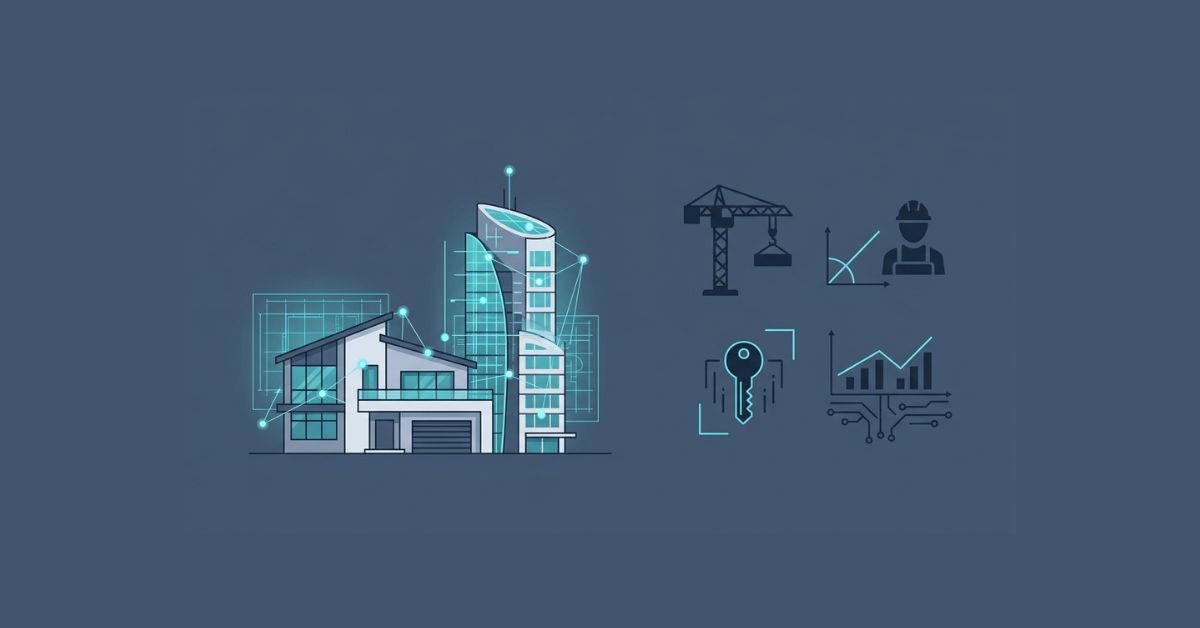
AI in real estate refers to the use of artificial intelligence technologies — machine learning, computer vision, predictive analytics, natural language processing, and autonomous AI agents — to automate, accelerate, and improve decision-making across every stage of the real estate lifecycle. For builders and construction site owners, AI in the real estate industry means faster site selection, more accurate cost estimation, automated construction monitoring, smarter project scheduling, and proactive maintenance — all delivering measurable reductions in cost, time, and risk.
If you are a builder, construction site owner, or real estate developer, you are operating in one of the most cost-sensitive, schedule-driven industries in the world. A three-week delay costs hundreds of thousands. A miscalculated land valuation can haunt a project for years. A maintenance failure on a completed asset erodes margins quietly and consistently.
Artificial intelligence for real estate is changing all of this — and in 2026, it has moved decisively from pilot programmes to live operational deployments. According to industry research, AI in the construction market alone is projected to grow from $13 billion in 2026 to nearly $28 billion by 2031. More telling: 82% of large construction firms plan to increase AI investment budgets this year, and 94% of mid-sized developers are either implementing or actively exploring AI strategies.
The builders extracting the most value from real estate AI are not the ones with the biggest technology budgets. They are the ones who identified specific, high-cost problems in their workflows — and applied AI precisely where it reduces that cost most effectively.
This guide explains exactly how AI in the real estate industry works for builders and site owners — the use cases delivering real ROI right now, the technologies behind them, and how to evaluate where to start.
- Why AI Matters for Builders and Construction Site Owners in 2026
- 8 High-Impact AI Use Cases for Real Estate, Builders and Developers
- AI-Driven Property Listings and Consumer Marketplaces
- AI Agents for Real Estate: The Biggest Shift in 2026
- AI in Construction: Specific Benefits for Site Owners and Builders
- Smart Buildings and AI Property Management: After the Build
- How to Get Started with AI in Real Estate: A Practical Guide for Builders
- Conclusion: The Gap Between AI Adopters and Laggards Is Growing
- Frequently Asked Questions
Why AI Matters for Builders and Construction Site Owners in 2026
The construction and development industry has historically been one of the slowest to adopt new technology. Manual processes, paper-based documentation, siloed data, and heavy reliance on individual expertise have been the norm. This is changing fast — not because technology companies are pushing it, but because the economic pressures builders face are making the status quo unsustainable.
- Labour shortages are pushing up costs and extending timelines on almost every project.
- Material price volatility makes accurate cost forecasting harder than ever.
- Regulatory complexity — permitting, zoning compliance, environmental assessment — is growing in every major market.
- Competition for well-located land has made site selection errors more expensive than at any point in recent history.
Against this backdrop, real estate AI provides builders and developers with three things that directly address these pressures: speed (processing data and generating insights in hours instead of weeks), accuracy (pattern recognition across large datasets that human analysts cannot replicate), and automation (handling repetitive, documentation-heavy tasks that currently consume expensive staff time).
Understanding how AI agents and autonomous systems are beginning to work across industries helps frame the opportunity for real estate specifically — these are not just analytical tools but systems that can monitor, decide, and act within defined boundaries.
8 High-Impact AI Use Cases for Real Estate, Builders and Developers
Here are the AI applications delivering measurable results in the real estate industry in 2026 — ranked by adoption maturity and ROI potential for builders and construction-focused organisations.
| Use Case | Who Benefits | AI Technology Used | Business Impact |
|---|---|---|---|
| Smart site selection | Builders, developers | Geospatial AI, predictive analytics | Reduces site evaluation from weeks to hours |
| AI property valuation | Developers, investors | Machine learning, AVM models | ±2% accuracy vs ±10% traditional appraisals |
| Construction monitoring | Site owners, contractors | Computer vision, drone AI | Up to 90% reduction in documentation time |
| Cost estimation & budgeting | Builders, project managers | ML cost prediction models | 15–25% reduction in budget overruns |
| AI agents for lead management | Real estate companies | Conversational AI, NLP | 24/7 lead nurturing, 3x conversion rates |
| Predictive maintenance | Property owners, managers | IoT sensors + AI analytics | 30–40% reduction in emergency repairs |
| Regulatory & permit automation | Developers, legal teams | Document AI, NLP | 50–70% faster permit processing |
| Smart building management | Property owners | AI + IoT integration | 20–35% reduction in energy costs |
1. AI-Powered Site Selection and Land Acquisition
Site selection is the highest-stakes decision in any development project — and it is also the most data-intensive. AI site selection tools aggregate geospatial data, zoning layers, utility infrastructure maps, traffic patterns, demographic trends, planning approval histories, and competitive developer activity into a unified scoring model. What previously required weeks of analyst time — commissioning broker reports, running market studies in Excel — now takes hours.
In May 2026, land acquisition AI platforms are already processing courthouse records, MLS data, building permit history, and real-time lot sales to give builders a live picture of competitive land positioning. Builders using these tools are identifying acquisition opportunities earlier and avoiding costly errors in land valuation that can take years to work through a project P&L.
Builder advantage: AI compresses the time from initial site identification to acquisition decision from weeks to hours — giving builders who use it a systematic first-mover advantage on the best available land.
2. AI Property Valuation and Development Underwriting
Automated valuation models (AVMs) powered by machine learning now deliver property valuations with accuracy levels of ±2% — compared to ±10% for traditional appraisal methods, and without the six-week wait. For development underwriting, predictive analytics real estate tools handle market data aggregation, comparable rent analysis, supply pipeline assembly, and initial pro forma generation automatically. Human judgment remains essential for assumption-setting, risk weighting, and capital structure decisions — but AI dramatically reduces the time to reach those decision points.
3. AI Construction Monitoring and Progress Tracking
Computer vision applied to drone footage is one of the most impactful AI applications for construction site owners in 2026. AI systems analyse site images and video, compare progress against scheduled milestones, flag deviations automatically, and generate daily progress reports without requiring a project manager to walk the site. Platforms like Fresco’s AI copilot are now widely adopted by construction superintendents — using video and voice transcription to automate daily logs, punch lists, and site documentation in real time during site walks. Users report a 90% reduction in information retrieval time. For builders managing multiple simultaneous projects, IoT sensors on construction sites combined with AI monitoring provide the kind of portfolio-level visibility that was previously impossible without large site management teams.
4. AI Cost Estimation and Budget Management
Cost overruns are one of the most persistent problems in construction — and AI is addressing them at multiple points. AI cost prediction models trained on historical project data, material price trends, labour market conditions, and project specifications can generate initial estimates significantly faster and more accurately than traditional quantity surveying approaches. Budget tracking tools that pull line items from payment applications and compare them against baseline budgets — flagging over-budget items automatically — are live on large-scale projects right now. The result: 15–25% reductions in budget overruns for organisations that have implemented AI cost management workflows.
Understanding the cost of AI development for these custom tools helps builders and developers make informed build-vs-buy decisions before committing to any specific platform.
AI-Driven Property Listings and Consumer Marketplaces
In 2026, property listing platforms and mobile apps have evolved from simple search engines into intelligent matchmakers. For developers and agencies selling new inventory, AI has changed the game for online marketplaces:
- Hyper-Personalised Discovery: Instead of users filtering by basic criteria, AI models analyze user behavior to suggest properties based on lifestyle, commute patterns, and “vibe.”
- Automated Content Generation: Platforms now use AI to instantly generate high-quality listing descriptions, virtual stagings, and even 3D walkthroughs from basic smartphone photos.
The Shift to Mobile: AI-First Real Estate Apps
The modern property app is a personal real estate assistant in your pocket, facilitating both buying and selling with ease:
- Augmented Reality (AR) Integration: Potential buyers can point their phone at a vacant lot or a building under construction and see the finished project rendered in real-time via the app.
- Instant Lead Qualification: For sellers, integrated AI chatbots within the app handle initial inquiries 24/7, qualifying leads and booking viewing appointments without a human agent.
AI Agents for Real Estate: The Biggest Shift in 2026
While individual AI tools address specific workflow problems, AI agents for real estate represent something more fundamental: autonomous systems that can monitor data, reason over it, and take defined actions across multiple stages of the real estate lifecycle — without constant human prompting.
In property management, AI agents handle resident communications 24/7, process maintenance requests, schedule contractors, and flag issues for human review only when decisions exceed defined parameters. Multifamily operators using AI agent platforms are running leaner site teams while reporting higher resident satisfaction scores — because young adult residents actively prefer interacting with a responsive AI assistant over waiting for an onsite manager.
In development operations, AI agents are beginning to connect the previously siloed stages of the development lifecycle — linking home plans, specifications, lot configurations, permitting data, and construction workflows into a unified operational intelligence layer. Builders running this kind of connected data infrastructure are reducing field errors, cutting rework from plan management disconnects, and accelerating sales readiness timelines.
The concept of agentic analytics for real estate — where AI agents continuously monitor operational and market data and surface insights automatically — is emerging as the most transformative near-term application for portfolio-scale real estate operators.
AI agents for real estate are autonomous software systems that operate within defined workflows without continuous human input. In construction, they monitor site progress, flag schedule deviations, and generate reports. In property management, they handle tenant communications, maintenance scheduling, and payment processing. In development, they aggregate market data, update underwriting models, and track permitting status. The key distinction from traditional software is that AI agents reason over data and adapt their responses — they do not simply execute pre-programmed rules.
AI in Construction: Specific Benefits for Site Owners and Builders
For construction site owners specifically, AI in the real estate industry is delivering measurable results across four operational areas.
Safety and risk management
Computer vision systems analyse live site footage to detect safety violations — workers without PPE, unsafe scaffolding configurations, vehicles in restricted zones — in real time. Predictive models flag high-risk periods based on project phase, weather conditions, and crew composition. Construction sites using AI safety monitoring have reported significant reductions in incident rates and substantial savings on insurance premiums.
Schedule optimisation and delay prediction
AI scheduling systems ingest weather forecasts, material delivery timelines, subcontractor availability, permit status, and current site progress to model the probability of schedule deviations before they occur. Site owners who previously discovered delays only after they happened now receive early warnings days or weeks in advance — giving them time to respond rather than react.
Material procurement and supply chain management
AI procurement tools monitor material price trends, supplier lead times, and project consumption rates to recommend optimal procurement timing and quantities. The same AI in construction and manufacturing principles that have transformed factory floor operations are now being applied to construction supply chains — reducing waste, minimising storage costs, and protecting against price volatility.
Automated documentation and compliance
Documentation burden — daily logs, inspection reports, RFI management, permit applications, compliance certificates — consumes a disproportionate amount of site management time on every project. Automating real estate workflows through AI and RPA (Robotic Process Automation) can reduce documentation time by 50–70%, freeing site managers to focus on the decisions that actually require their expertise.

Smart Buildings and AI Property Management: After the Build
For property owners and developers whose interest extends beyond construction to ongoing asset management, AI property management tools are delivering sustained ROI across the asset lifecycle.
Predictive maintenance — fixing problems before they happen
IoT sensors embedded in building systems — HVAC, lifts, electrical, plumbing — continuously feed data to AI models that identify deterioration patterns before they cause failures. Property owners using predictive maintenance AI report 30–40% reductions in emergency repair costs and significantly lower tenant disruption rates. For large commercial portfolios, the cumulative saving across multiple assets is substantial. This is the same logic that drives AI assistant for property management platforms — having an intelligent system monitor everything continuously so property managers only need to act when action is genuinely required.
Energy efficiency and sustainability
Smart building AI optimises energy consumption by learning occupancy patterns, weather conditions, and usage behaviour to control HVAC, lighting, and electrical systems dynamically. Buildings using AI energy management consistently achieve 20–35% reductions in energy costs — a meaningful improvement to operating margin that also supports ESG commitments and green building certifications.
Dynamic pricing and revenue optimisation
For rental assets — commercial, residential, or mixed-use — AI pricing models analyse occupancy rates, market demand signals, seasonal patterns, and comparable property performance to recommend rental rates that maximise revenue without sacrificing occupancy. Properties using AI pricing consistently outperform manually managed peers on net operating income.
For real estate developers building mixed-use or residential rental assets, AI property management tools pay for themselves quickly. The combination of reduced maintenance costs, lower vacancy rates, optimised energy spend, and smarter pricing typically delivers ROI within 12–18 months of deployment.
How to Get Started with AI in Real Estate: A Practical Guide for Builders
The most common mistake builders and developers make when evaluating real estate AI is trying to solve everything at once. The most successful implementations in 2026 share a consistent pattern: they started with one specific, costly problem and used AI to solve it definitively before expanding.
Identify your highest-cost problem
Where does your organisation consistently lose money or time? Site selection errors? Cost overruns? Schedule delays? Documentation overhead? Pick one. The clearer your problem definition, the more precisely you can match an AI solution to it.
Audit your data readiness
AI is only as good as the data it learns from. Before selecting any tool or partner, assess what data you have, where it lives, and how clean and structured it is. Most builders discover that valuable operational data is scattered across disconnected systems — plans in one place, specifications in another, cost data in spreadsheets, field reports in email. Connecting this data is often the most important step before any AI can be deployed effectively.
Choose build vs. integrate vs. buy
Some AI problems have ready-made solutions available in PropTech platforms. Others require custom development because your data, workflows, or competitive requirements are unique. Understanding this distinction before committing budget saves significant time and money. For most builders, the answer is a combination — integrating existing AI tools for standard workflows while building custom solutions for the processes that genuinely differentiate their operation.
Engage a specialist AI development partner
Building custom AI development for real estate requires expertise in machine learning, data engineering, system integration, and real estate domain knowledge. GrapesTech Solutions delivers end-to-end AI development for construction and real estate businesses — from initial scoping and data architecture through to deployment and post-launch support, with 24/7 availability and transparent pricing.
For real estate developers building mixed-use or residential rental assets, AI property management tools pay for themselves quickly. The combination of reduced maintenance costs, lower vacancy rates, optimised energy spend, and smarter pricing typically delivers ROI within 12–18 months of deployment.
Conclusion: The Gap Between AI Adopters and Laggards Is Growing
In 2026, the gap between builders and developers who are running AI in production workflows and those still managing projects in spreadsheets and email is widening fast. This is not a technology trend to monitor from a distance — it is a competitive reality that is already reshaping margins, timelines, and asset performance across the real estate industry.
The businesses extracting the most value from artificial intelligence for real estate are not necessarily the largest or the most technically sophisticated. They are the ones that started with a specific problem, chose their first use case carefully, and built from a foundation of connected operational data. That approach is available to any builder or developer willing to take the first step.
GrapesTech Solutions provides specialist AI development for real estate businesses — combining deep AI expertise with practical understanding of construction and property workflows. Whether you are exploring your first AI tool or ready to build a custom system, we help you move from concept to production quickly and without the risk of misaligned investment.
Ready to explore AI for your real estate or construction business?
Book a free consultation with GrapesTech Solutions — we will assess your workflows, identify your highest-value AI opportunities, and give you a clear, honest implementation roadmap.
Frequently Asked Questions
Artificial intelligence is used in real estate across every stage of the development and ownership lifecycle. For builders and developers: AI is used for site selection, property valuation, development underwriting, cost estimation, construction progress monitoring, safety management, and permit processing. For property owners and managers: AI powers predictive maintenance, energy optimisation, tenant communication, dynamic pricing, and portfolio analytics. AI agents are increasingly used to automate entire workflows — handling communications, scheduling, documentation, and reporting with minimal human intervention.
ROI varies significantly by use case. Construction monitoring AI typically delivers 20–30% reductions in rework costs and documentation time. AI cost estimation tools reduce budget overruns by 15–25%. Predictive maintenance AI reduces emergency repair costs by 30–40%. AI site selection tools compress evaluation timelines from weeks to hours — the value of which depends on the cost of the land decision being made. For most builders deploying AI in two or three key workflows, total ROI is positive within 12–18 months of implementation.
Yes. AI agents for real estate are operational in production environments across property management, development monitoring, and leasing workflows in 2026. The most mature applications are in property management (tenant communications, maintenance scheduling) and construction monitoring (daily reporting, schedule deviation alerts). Development-stage agentic systems — covering multi-step workflows from site acquisition through to asset stabilisation — are being deployed by the most technology-forward institutional development teams and will become more widely available over the next 12–18 months.